Decoding Your Money
FinStream’s Decoding Your Money is a new podcast designed to help investors, retirees and financial professionals better understand the increasingly complex decisions surrounding money, financial planning and retirement. Hosted by award-winning financial journalist Robert Powell, the podcast features conversations with leading researchers, financial advisors and subject matter experts on topics ranging from financial planning and taxes to insurance, investing, employee benefits, retirement and estate planning.
Featured Tools
Each new episode of Decoding Your Money links to an online tool to further explore your financial options.
- Medigap Lens – Choosing a Medicare Supplement (Medigap) plan shouldn’t mean guessing which letter leaves you better off. The Medigap Lens compares all ten standardized Medigap plans side by side, showing not just the monthly premium but the full picture: premiums plus what each plan still leaves you to pay over a year. Enter your ZIP code to see the plans available in your area, then review transparent annual cost projections for each option.
- Annuity Lens – Worried about outliving your savings? The Annuity Lens shows you three ways to turn a nest egg into a paycheck for life, compared side by side on your own numbers. Using illustrative rates, it lays out how different annuity approaches stack up for your situation so you can see the trade-offs before you commit. Enter your ZIP code to get a personalized comparison.
Each tool is intended as a lens, not a directive, designed to give you clarity rather than push a particular choice.
Latest Podcast Episodes
Are Multi-Year Guaranteed Annuities Safer Than Bank CDs?
Try our free AnnuityLens to compare Medicare Supplement Plans @ https://www.finstream.tv/annuitylens/
Multi-year guaranteed annuities (MYGAs) offer conservative retirement savers predictable fixed rates, tax-deferred growth, and yields that often beat comparable bank ...certificates of deposit. But chasing the highest advertised interest rate can expose your retirement savings to unexpected balance-sheet risks.
In this episode of Decoding Your Money, Robert Powell, CFP, RMA, sits down with Sheryl J. Moore, head of third-party market research firm Wink (winkintel.com), to uncover what happens beneath the surface of high-yielding annuities. They discuss why smaller or private-equity-backed carriers offer outsized rates, why paid-for rating agency scores have blind spots, and how state guaranty associations differ from FDIC insurance.
Key Discussion Points:
Chasing the highest yield on multi-year guaranteed annuities can jeopardize your retirement savings if a company fails. Learn how to evaluate insurer risk today.
Annuity market intelligence expert Sheryl Moore joins Bob Powell to discuss the dangers of prioritizing high interest rates over the financial stability of an insurance provider. When you search for the best fixed annuity options, it is tempting to pick the highest payout, but choosing a less established company could leave your capital at risk if the firm becomes insolvent and cannot meet its payment obligations.
This conversation provides a framework for evaluating the creditworthiness of insurance companies before you commit your funds. Understanding the nuances of annuity market intelligence helps you balance the need for growth with the critical requirement of long-term security. By vetting the carrier behind your policy, you can protect your principal from unnecessary exposure to company insolvency.
Subscribe to FinStream for weekly personal finance and retirement planning breakdowns, and let us know in the comments if you have questions about how you evaluate the safety of your own retirement assets.
Chapters:
00:00 - The Core Risk: Why the Highest Annuity Rate Can Backfire
00:20 - What Is a MYGA? How 3-, 5-, and 7-Year Terms Work
01:55 - MYGAs vs. Bank CDs: Tax Deferral and 10% Penalty-Free Withdrawals
03:15 - Renewal Traps & First-Year Rate Bonuses Explained
04:45 - Judging Insurer Financial Strength & "Vital Signs" Reports
06:10 - FDIC vs. State Guaranty Associations ($250,000 Coverage Limits)
07:45 - Private Equity Ownership & The "Bermuda Triangle" Scrutiny
09:30 - The Buyer's Checklist: Free-Look Windows & Agent Turnover
KEY STRATEGIC TAKEAWAYS:
• Look Beyond the Yield: An extra 0.25% or 1% in interest means nothing if the carrier lacks financial durability. Always evaluate the insurer's ownership structure, track record, and claims-paying ability.
• Respect the $250,000 Cap: Annuities are not backed by the U.S. government or the FDIC. Most states cap guaranty association protections at $250,000 per insurer, making carrier diversification critical for larger balances.
• Shop Renewals and Scrutinize Bonuses: Insurers routinely offer higher rates to new money than renewing contracts, and first-year bonus rates generally come with lower base crediting rates over the full term.
• Use Your Free-Look Period: Most states mandate a free-look window after delivery allowing you to cancel an annuity and receive a full refund if you change your mind.
#Annuities #MYGA #RetirementPlanning #PersonalFinance #FixedIncome #CertificatesOfDeposit #WealthManagement #DecodingYourMoneyShow MoreAre Multi-Year Guaranteed Annuities Safer Than Bank CDs?
Try our free AnnuityLens to compare Medicare Supplement Plans @ https://www.finstream.tv/annuitylens/ Multi-year guaranteed annuities (MYGAs) offer conservative retirement savers predictable fixed rates, tax-deferred growth, and yields that ...
Try our free AnnuityLens to compare Medicare Supplement Plans @ https://www.finstream.tv/annuitylens/
Multi-year guaranteed annuities (MYGAs) offer conservative retirement savers predictable fixed rates, tax-deferred growth, and yields that often beat comparable bank ...certificates of deposit. But chasing the highest advertised interest rate can expose your retirement savings to unexpected balance-sheet risks.
In this episode of Decoding Your Money, Robert Powell, CFP, RMA, sits down with Sheryl J. Moore, head of third-party market research firm Wink (winkintel.com), to uncover what happens beneath the surface of high-yielding annuities. They discuss why smaller or private-equity-backed carriers offer outsized rates, why paid-for rating agency scores have blind spots, and how state guaranty associations differ from FDIC insurance.
Key Discussion Points:
Chasing the highest yield on multi-year guaranteed annuities can jeopardize your retirement savings if a company fails. Learn how to evaluate insurer risk today.
Annuity market intelligence expert Sheryl Moore joins Bob Powell to discuss the dangers of prioritizing high interest rates over the financial stability of an insurance provider. When you search for the best fixed annuity options, it is tempting to pick the highest payout, but choosing a less established company could leave your capital at risk if the firm becomes insolvent and cannot meet its payment obligations.
This conversation provides a framework for evaluating the creditworthiness of insurance companies before you commit your funds. Understanding the nuances of annuity market intelligence helps you balance the need for growth with the critical requirement of long-term security. By vetting the carrier behind your policy, you can protect your principal from unnecessary exposure to company insolvency.
Subscribe to FinStream for weekly personal finance and retirement planning breakdowns, and let us know in the comments if you have questions about how you evaluate the safety of your own retirement assets.
Chapters:
00:00 - The Core Risk: Why the Highest Annuity Rate Can Backfire
00:20 - What Is a MYGA? How 3-, 5-, and 7-Year Terms Work
01:55 - MYGAs vs. Bank CDs: Tax Deferral and 10% Penalty-Free Withdrawals
03:15 - Renewal Traps & First-Year Rate Bonuses Explained
04:45 - Judging Insurer Financial Strength & "Vital Signs" Reports
06:10 - FDIC vs. State Guaranty Associations ($250,000 Coverage Limits)
07:45 - Private Equity Ownership & The "Bermuda Triangle" Scrutiny
09:30 - The Buyer's Checklist: Free-Look Windows & Agent Turnover
KEY STRATEGIC TAKEAWAYS:
• Look Beyond the Yield: An extra 0.25% or 1% in interest means nothing if the carrier lacks financial durability. Always evaluate the insurer's ownership structure, track record, and claims-paying ability.
• Respect the $250,000 Cap: Annuities are not backed by the U.S. government or the FDIC. Most states cap guaranty association protections at $250,000 per insurer, making carrier diversification critical for larger balances.
• Shop Renewals and Scrutinize Bonuses: Insurers routinely offer higher rates to new money than renewing contracts, and first-year bonus rates generally come with lower base crediting rates over the full term.
• Use Your Free-Look Period: Most states mandate a free-look window after delivery allowing you to cancel an annuity and receive a full refund if you change your mind.
#Annuities #MYGA #RetirementPlanning #PersonalFinance #FixedIncome #CertificatesOfDeposit #WealthManagement #DecodingYourMoneyShow More The Medicare Choice You Can't Undo (Medigap vs Advantage Reality)
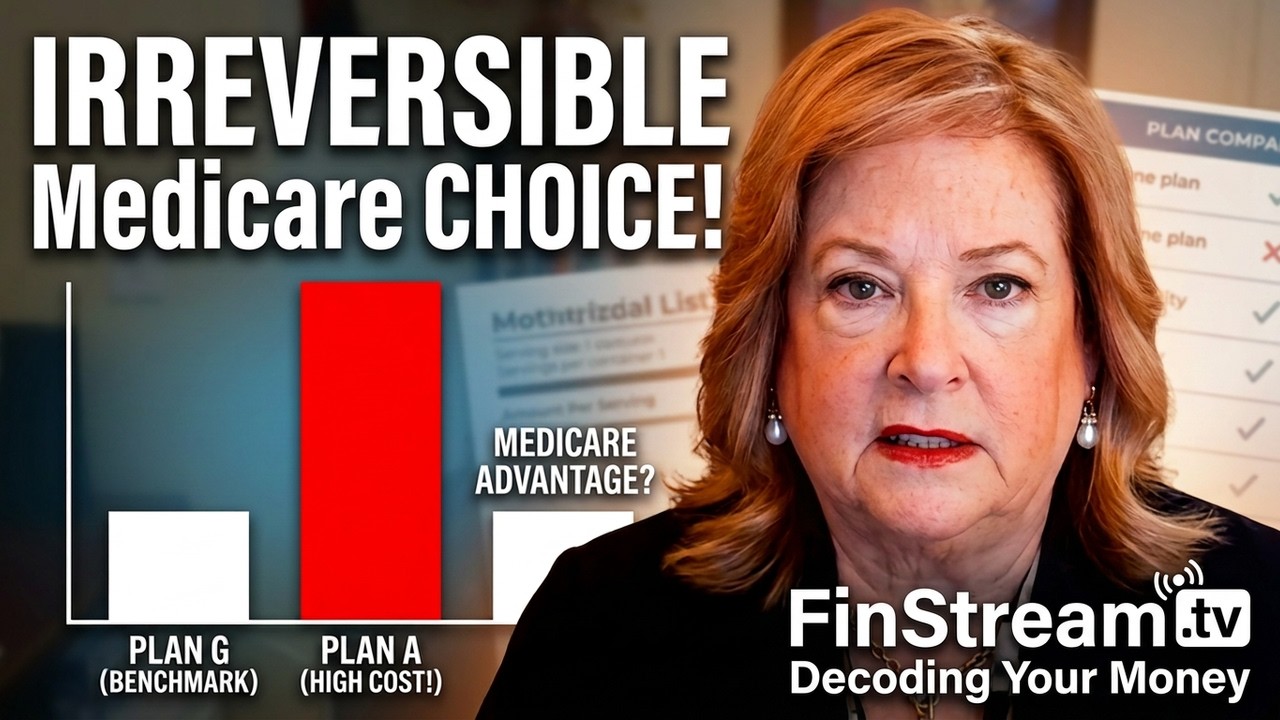
Try our free MedigapLens too to compare Medicare Supplement Plans @ https://www.finstream.tv In 46 states, enrolling in Medicare Advantage at 65 can permanently lock you out of Medigap. In this episode of FinStream's Decoding Your Money, Katy ...
Try our free MedigapLens too to compare Medicare Supplement Plans @ https://www.finstream.tv
In 46 states, enrolling in Medicare Advantage at 65 can permanently lock you out of Medigap. In this episode ...of FinStream's Decoding Your Money, Katy Votava joins Bob Powell to break down the hidden $12,000 stop-loss risk and how dropped plans trigger guaranteed rights.
It is one of the most dangerous assumptions retirees make when turning 65:
“I’ll just take the zero-premium Medicare Advantage plan now while I’m healthy. If I get sick down the road, I’ll switch over to original Medicare and Medigap.”
In 46 states, you can’t.
Unless you live in New York, Connecticut, Massachusetts, or Maine, your initial six-month open enrollment window at age 65 is your only guaranteed shot at getting Medigap without health questions.
Once that window closes, insurers can subject you to medical underwriting. If you develop cancer, heart disease, or a chronic illness, private supplemental carriers can—and routinely do—reject your application.
In my latest conversation with Medicare expert Katy Votava, Ph.D. (author of Making the Most of Medicare), we unpacked the true math behind the healthcare decumulation ledger:
• The $12,000 Stop-Loss Reality: Why paying ~$2,300 a year for Medigap Plan G caps your total out-of-pocket medical exposure at roughly $5,200, while a “zero-premium” Advantage plan can expose you to more than $12,000 once serious illness strikes.
• The Cancellation Golden Ticket: Why the recent wave of insurers dropping Medicare Advantage plans across counties actually triggers a rare federal privilege to buy Medigap with zero health questions.
• The Paradox of Choice: Why Medigap plans offering fewer benefits (like Plan B) are often more expensive than comprehensive Plan G.
• The 63-Day Moving Trap: Why moving to Florida or Texas without updating your coverage within 63 days can leave you completely uninsurable.
Before you or a client finalize open enrollment paperwork before December 7, understand the long-term trade-offs.Show More Will Your Retirement Income Be Enough? Morningstar’s Spencer Look - DYM Episode 15
How much does long-term care change the odds of running short of money in retirement? Spencer Look, associate director of retirement studies at the Morningstar Center for Retirement and Policy Studies, joins Bob Powell on Decoding Your Money to ...
How much does long-term care change the odds of running short of money in retirement?
Spencer Look, associate director of retirement studies at the Morningstar Center for Retirement and Policy Studies, ...joins Bob Powell on Decoding Your Money to explain what Morningstar’s retirement simulations reveal about financial security in later life.
Look discusses why projected shortfalls change sharply when the model includes paying for long-term care out of pocket, how working longer and delaying Social Security claiming can improve outcomes, and why consistent retirement plan participation matters. He also explains research showing that essential expenses can consume a larger share of income as people age.
The conversation covers retirement account cash-outs, annuities inside workplace plans and proposals to address long-term care risk. Look closes with practical steps: understand your care options, review your savings rate and, if possible, contribute enough to receive your full employer match.
Five search tags: retirement planning; Spencer Look; Morningstar retirement research; long-term care costs; Social Security claiming
Subscribe to FinStream.tv for weekly financial planning breakdowns, and let us know in the comments if you are concerned about covering healthcare expenses in your later years.Show More Retirement Planning vs. Reality - What You’re Getting Wrong: DYM with Tim Steffen
Master essential retirement planning rules to avoid common tax traps and penalties when you start taking money out. You spend your entire career learning how to save and invest for retirement, but what happens when it’s time to take the money ...
Master essential retirement planning rules to avoid common tax traps and penalties when you start taking money out.
You spend your entire career learning how to save and invest for retirement, ...but what happens when it’s time to take the money out? In this episode of FinStream's Decoding Your Money, host Bob Powell sits down with Tim Steffen, CPA, CFP®, CPWA®, and Director of Advanced Planning at Baird Wealth Management, to decode the complex, unforgiving tax and withdrawal rules that trip up retirees.
In this episode, we cover:
The 3 Core Rules of Retirement Accounts: Taxes, early withdrawal penalties, and mandatory distributions.
Rollover Traps: Direct vs. indirect rollovers, the strict 60-day rule, and avoiding unexpected tax bills.
Tax Optimization Tactics: The Net Unrealized Appreciation (NUA) strategy for company stock and separating after-tax dollars using the "cream in the coffee" rule.
Early Access Without Penalty: Navigating the Rule of 55 and Section 72(t) substantially equal periodic payment schedules.
RMD Masterclass: Current age thresholds (73 vs. 75), first-year delay mechanics, and why the "first dollars out" rule impacts Roth conversions.
Tax-Free Giving: How Qualified Charitable Distributions (QCDs) keep your Adjusted Gross Income (AGI) down and protect Medicare premiums.
Learn the essential rules for accessing retirement funds when you need them. Avoid common pitfalls and plan your next move.
Tim Stefan joins the discussion to challenge the standard advice of never touching your nest egg. While contributing automatically is a cornerstone of long-term success, life circumstances sometimes require you to tap into your assets sooner than expected.
We break down the nuances of specific withdrawal rules that often go overlooked by investors. By understanding how to navigate these regulations correctly, you can make informed decisions about your retirement savings without jeopardizing your broader financial planning goals.
Subscribe to FinStream.tv for weekly financial planning breakdowns, and let us know in the comments if you have questions about your own retirement strategy.
0:00 The Hidden Rulebook of Retirement Accounts
2:04 Three Fundamental Rules for Retirement Dollars
4:21 Managing Your 401k After Changing Jobs
7:06 Direct vs. Indirect Rollovers Explained
10:49 Mixing Pre-Tax and After-Tax Contributions
14:34 Net Unrealized Appreciation: A Unique Tax Strategy
18:53 Avoiding the 10% Early Withdrawal Penalty
26:08 Mastering Required Minimum DistributionsShow More Year-End Tax Planning Masterclass: 26 Strategies for 2026 | John Nersesian & Bob Powell
Don’t wait until December 31st to start thinking about your taxes. Proactive year-end planning is all about taking control of your income, optimizing your investment portfolio, and keeping more of what you earn through smart, multi-year tax ...
Don’t wait until December 31st to start thinking about your taxes. Proactive year-end planning is all about taking control of your income, optimizing your investment portfolio, and keeping more of ...what you earn through smart, multi-year tax planning.
In episode 13 of FinStream's Decoding Your Money, Bob Powell is joined by John Nersesian, founder of Nersesian Wealth Education, for a comprehensive masterclass covering the essential four-pillar checklist: Income Tax, Investments, Retirement Accounts, and Wealth Transfer.
Key Topics & Chapters:
00:00 – The Importance of Proactive Year-End Planning
02:30 – Income Tax Brackets, Capital Gains & Surtaxes (NIIT / Medicare)
05:40 – Itemized Deductions & New Tax Law Changes (SALT, Senior Breaks)
08:00 – Managing Tax Brackets & Bracket Stuffing Strategies
14:50 – Safe Harbor Withholding Rules & State Tax Considerations
18:30 – Section 199A (QBI) Deductions for the Self-Employed
22:20 – Tax-Loss Harvesting & Overcoming the Wash Sale Rule
29:00 – The Behavioral Power of Portfolio Rebalancing
34:10 – Retirement Contributions: Limits, Matches & Roth vs. Traditional
39:25 – The "Triple Tax Advantage" of Health Savings Accounts (HSAs)
43:35 – Strategic Multi-Year Roth Conversions
46:30 – Beneficiary Designations & The 10-Year Inherited IRA Rule
49:30 – RMD Deadlines, Calculations & Reduced Penalties
53:05 – Coordinating Social Security & Medicare Open Enrollment
56:50 – Annual Gifting & 529 Plan Front-Loading Tactics
01:00:30 – Charitable Giving: Bunching Deductions, Appreciated Assets & QCDs
01:09:40 – Key Milestone Ages to Remember
Subscribe to FinStream.tv for weekly financial planning breakdowns, and let us know in the comments what money topic you want us to decode next. Check out the free financial planning tools, including the Ai Wealth Planner, on our website at this link: https://www.finstream.tv/financial-planning-tools/
Resources & Connect:
Guest: John Nersesian (Nersesian Wealth Education)
Host: Bob Powell
Disclaimer: This content is provided for educational and informational purposes only and does not constitute formal legal, accounting, or personalized financial advice.Show More Retirement is More Than Money: How To Find Purpose, Income & Peace Of Mind
Retirement planning usually begins with a number: How much money will you need? But leaving work also raises harder questions. Who are you without your career? What will give your days meaning? And after decades of saving, how do you give ...
Retirement planning usually begins with a number: How much money will you need?
But leaving work also raises harder questions. Who are you without your career? What will give your days ...meaning? And after decades of saving, how do you give yourself permission to spend?
Suzanne Norman, a longtime financial educator, executive coach and fellow with LIMRA, joins Bob Powell to explain why retirement requires both financial and emotional preparation.
They discuss how retirees can build a new sense of purpose, why many people feel guilty spending their own savings, and how predictable income can reduce the fear of running out of money. Norman also explains why Generation X may face a more difficult retirement than previous generations, how caregiving affects women’s financial security, and why families should prepare for cognitive decline and financial fraud before a crisis occurs.
The conversation offers practical guidance for people approaching retirement, retirees struggling to spend and families trying to protect aging loved ones.
0:00 The Emotional Side of Retirement
2:58 Finding Your Purpose Before Retiring
5:07 The Power of Community and Connection
10:08 The License to Spend Your Savings
15:47 Creating Certainty with Guaranteed Income
22:57 The Peak 65 and Gen X Reality
29:17 Empowering Women in Financial PlanningShow More